When newcomers first step into Bitcoin, there is a natural temptation to leave coins sitting on a centralized exchange. It feels convenient, familiar, and deceptively safe — until the inevitable happens.
Anyone who has spent time in this industry has watched custodial third parties collapse overnight. From the historic Mt. Gox implosion in 2014 to the sudden multi-billion-dollar insolvencies of FTX, Celsius, and BlockFi in 2022, the lesson is always the same: “Not your keys, not your coins.”
To eliminate third-party counterparty risk, the standard advice is clear: save your Bitcoin offline. Dedicated hardware wallets and open-source signing devices are brilliant tools for securing wealth. But moving offline introduces a deeper principle that sits at the very heart of both cybersecurity and Bitcoin:
“Don’t trust, verify.”
There is a huge difference between removing exchange risk and blindly trusting a single piece of hardware or closed firmware. The more amateur a project or the newer the codebase, the more critical community review is required before trusting it with life savings. If the underlying mathematics used to generate your private keys are flawed, your offline cold storage offers zero defence.
The devastating July 2026 Coldcard PRNG vulnerability proved this in brutal fashion, resulting in over $130 million in Bitcoin drained across automated on-chain sweeps.
Here is the full technical breakdown of the exploit, why 40-bit encryption is trivial to break, why flashing new firmware leaves existing wallets completely vulnerable, and how operators can build a multi-layered custody stack.
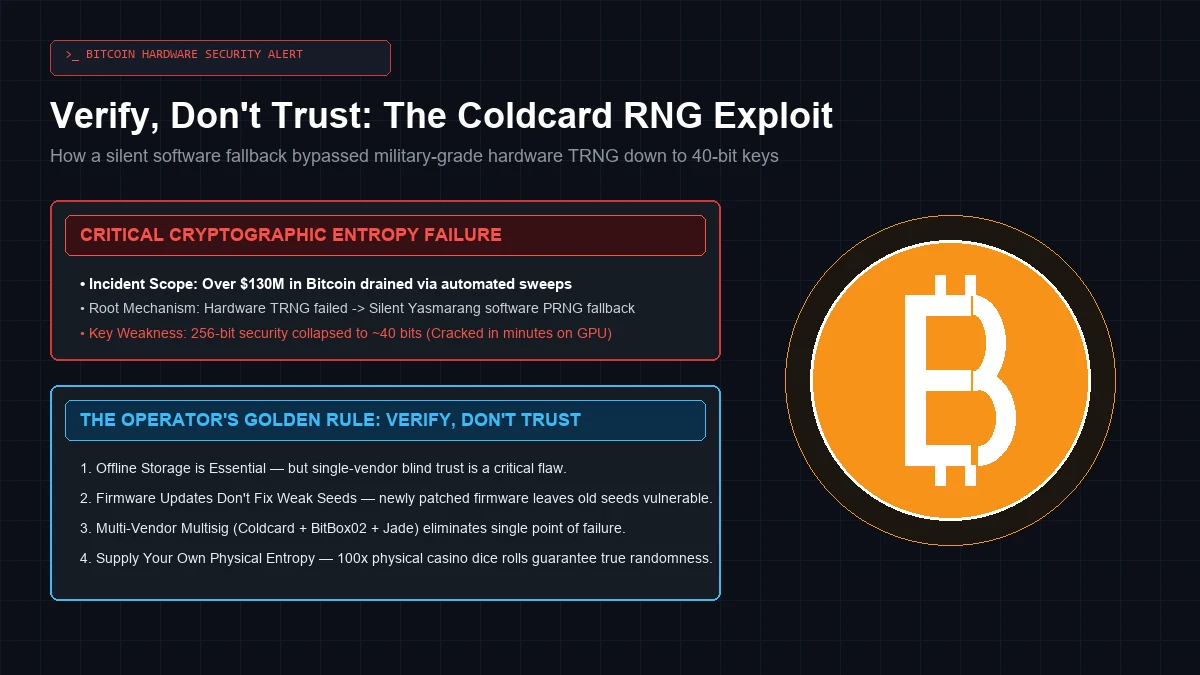 The Coldcard PRNG incident: an overview of the entropy collapse, on-chain theft, and the operator’s golden rules for self-custody.
1. The Cryptographic Flaw: When Hardware TRNG Fails Silently
When you set up a Bitcoin hardware wallet, you expect military-grade physical entropy.
Standard Bitcoin private keys require 256 bits of cryptographically secure randomness. In a properly engineered device — such as a Trezor, BitBox02, or an intact Coldcard — entropy is harvested from a dedicated hardware True Random Number Generator (TRNG) located on the secure element. These chips sample physical avalanche noise across microchip diodes to generate true thermal randomness.
A 256-bit keyspace contains approximately $1.15 \times 10^{77}$ possible combinations. That is more combinations than there are atoms in the observable universe. It is mathematically impossible to brute-force a true 256-bit key, even if you harnessed all the supercomputing power on Earth.
┌─────────────────────────────────────────────────────────────────────────────────────────────┐
│                             The Entropy Collapse Comparison                                 │
├───────────────────────────────┬───────────────────────────────┬─────────────────────────────┤
│ Intended TRNG (256-Bit)       │ Mk4 / Mk5 / Q Bug (~72-Bit)   │ Mk2 / Mk3 Bug (~40-Bit)     │
│ • 1.15 x 10^77 combinations   │ • ~4.72 x 10^21 combinations  │ • ~1.09 x 10^12 keys        │
│ • Mathematically unbreakable  │ • Targeted cluster search     │ • Cracked in minutes on GPU │
└───────────────────────────────┴───────────────────────────────┴─────────────────────────────┘
The Bug: A Fatal 40-Bit Software Fallback
A firmware build configuration bug, quietly introduced in March 2021 (affecting v4.0.1 through v4.1.9 on Mk2/Mk3 devices, and early builds on Mk4, Mk5, and Q), caused the seed-generation routine to fail to communicate with the hardware TRNG.
In security-critical systems, a hardware failure should trigger a hard panic and immediately halt. Instead, the device silently degraded to an internal software pseudo-random number generator (PRNG) called Yasmarang.
Even worse, this software PRNG was seeded with predictable, low-entropy values:
- The microcontroller’s internal Unique ID (UID) registers.
- System timer tick counters measured at boot.
Because device UIDs follow predictable manufacturer ranges and boot timers only vary within a narrow window of microseconds, the effective entropy collapsed:
- Mk2 and Mk3 devices were crushed down to roughly 40 bits of entropy.
- Mk4, Mk5, and Q devices were reduced to roughly 72 bits of entropy.
2. 40 Bits Is Not Encryption: Real-World GPU Key Recovery
To put this in perspective: 40-bit encryption provides zero security against modern hardware.
A 40-bit keyspace contains only $2^{40} \approx 1.099 \text{ trillion}$ candidate seeds. On an 8x NVIDIA RTX 4090 compute cluster running optimised SHA-256 derivation pipelines, a trillion hashes can be computed and checked in under 22 minutes.
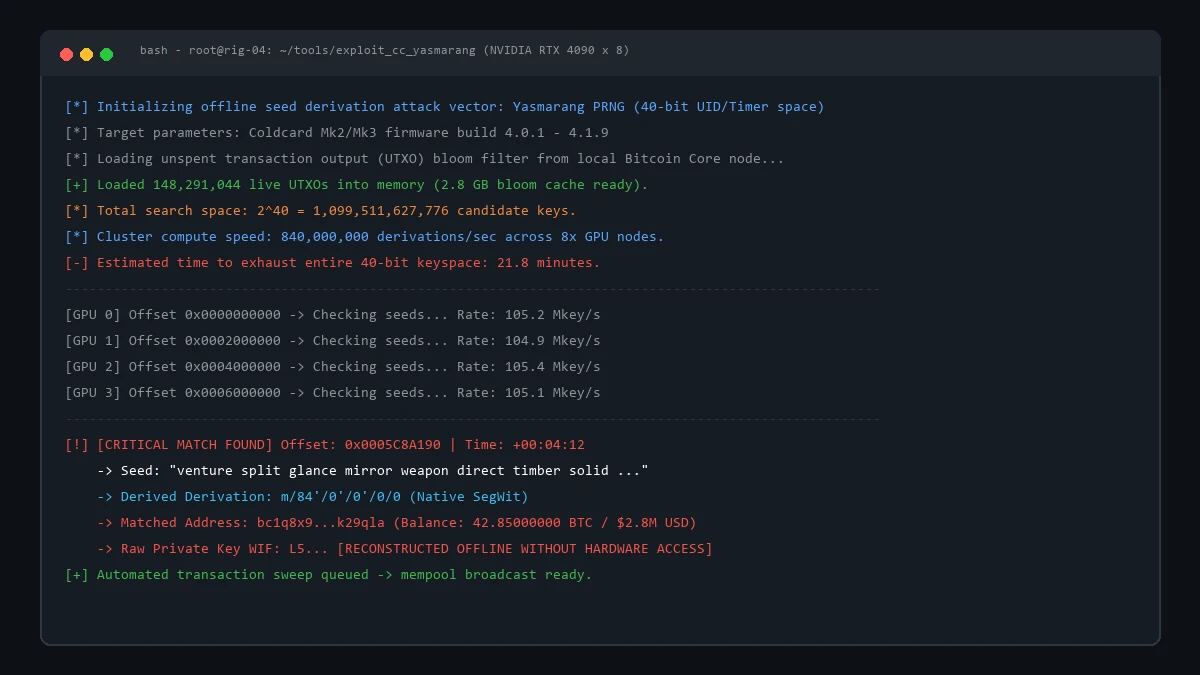 Simulated Linux terminal output of an offline seed recovery pipeline exhausting the 40-bit search space and matching unspent transaction outputs (UTXOs).
The attackers did not need physical access to any Coldcard device. They did not need a supply-chain intercept or physical tampering.
The attack was executed entirely offline:
- Keyspace Exhaustion: Attackers pre-computed the candidate private keys across the narrow 40-bit seed space.
- Address Derivation: They derived standard Native SegWit (
bc1q...) and P2SH Bitcoin addresses for each candidate key. - UTXO Bloom Filtering: They cross-referenced candidate addresses against a local Bitcoin Core node’s unspent transaction output (UTXO) database.
- Mempool Broadcasting: When an address with a balance was matched, the private key was already known. The attackers constructed signed raw transactions and broadcast them directly to the Bitcoin mempool.
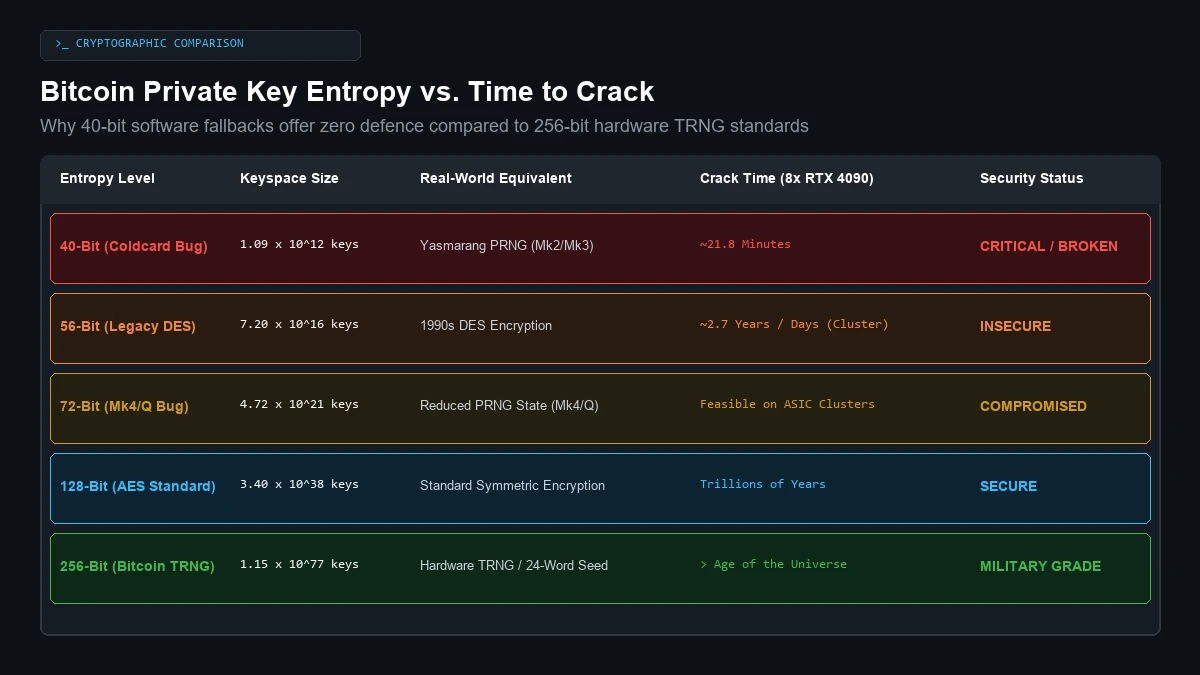 Comparison of cryptographic entropy levels: 40-bit software fallbacks are trivial to crack compared to 256-bit hardware TRNG standards.
3. Timeline of the Drain & The “Firmware Update Trap”
The real-world impact hit the blockchain in massive automated waves:
- March 2021: Vulnerable firmware build configurations are released into production. Users worldwide generate mathematically crippled seeds on air-gapped devices.
- July 30, 2026: Threat actors launch an automated on-chain sweep. In a single 41-minute burst, over 1,000 victim addresses were drained of approximately $70 million in BTC.
- August 2026: Total stolen funds climb past $130 million as secondary address derivations are swept.
- Emergency Patches Released: Coinkite released emergency firmware updates (v4.2.0 for Mk3; v5.6.1 for Mk4/Mk5; v1.5.1Q for Coldcard Q) restoring the hardware TRNG binding.
⚠️ The Critical Warning: Updating Firmware Is NOT Enough
The single most dangerous misconception among users is assuming that plugging in their device and updating the firmware secures their Bitcoin.
Flashing new firmware does NOT fix an existing weak seed.
A firmware update only ensures that future seeds generated on the device will use the hardware TRNG. If your 24-word seed phrase was generated on a vulnerable firmware version between March 2021 and July 2026, that seed was born weak and remains permanently weak on the blockchain.
Flashing firmware without moving your funds leaves your private keys completely exposed to offline brute-force scripts.
The only fix is to generate a brand-new seed on patched firmware and immediately migrate all UTXOs.
; Compromise Status by Wallet Generation State
[Factory Automatic Seed on Vulnerable Firmware] -> ❌ COMPROMISED (Drain Imminent)
[Firmware Updated But Same Old Seed Kept]        -> ❌ COMPROMISED (Seed is still weak)
[Fresh Seed Generated on Patched Firmware]      -> ✅ SECURE (True 256-bit TRNG)
[Manual 100x Physical Dice Rolls as Entropy]    -> ✅ SECURE (User supplied true entropy)
[Seed Protected with High-Entropy BIP39 Salt]   -> ⚠️ PARTIALLY MITIGATED (Depends on salt strength)
4. The AI Vulnerability Era: A Double-Edged Sword
One of the most fascinating developments in the aftermath of the Coldcard disclosure was the role played by autonomous AI vulnerability models.
Following the incident, the open-source security community mobilized. Independent white-hat researchers deployed autonomous AI code-auditing models across 390 open-source Bitcoin and cryptographic repositories. In a single 27.5-hour automated sprint, AI models discovered 85 critical cryptographic bugs, including unseeded PRNG fallbacks, biased nonce generation in ECDSA signature routines, and buffer overflows in embedded signing firmware.
As someone who uses autonomous AI workflows to build and secure infrastructure, this highlights the rapid evolution of security auditing:
- The Defender’s Speed Advantage: White-hat communities can now audit complex, multi-repository cryptographic ecosystems in hours rather than months, identifying silent edge cases that humans overlooked for years.
- The Adversary’s Pipeline: The exact same AI models are available to threat actors. Attackers are running automated code-ingestion pipelines to hunt for zero-day entropy flaws across smaller, newer open-source cryptocurrency projects.
- The Importance of Mature Codebases: The newer or more experimental a repository is, the higher the likelihood that subtle cryptographic fallbacks exist. Security demands battle-tested code and open community scrutiny.
5. The Operator’s Defence Stack: Actionable Custody Rules
If you are holding significant value in Bitcoin, relying on a single hardware wallet is a single point of failure. Here are the actionable, engineering-first practices you should implement:
1. Split Large Holdings Across Multiple Wallets
Never store your entire stack under a single seed phrase. Segment your funds across separate wallets with independent private keys. If an unforeseen vulnerability compromises one device or seed, your broader treasury remains completely safe.
2. Multi-Vendor Collaborative Multisig (2-of-3)
Single-signature cold storage leaves you vulnerable to single-vendor supply-chain bugs, firmware backdoors, and TRNG failures.
Set up a 2-of-3 multisig quorum across hardware devices from completely different manufacturers running distinct codebases:
- Key 1: Coldcard (MicroPython / Secure Element)
- Key 2: BitBox02 (Embedded C / Dual Chip Architecture)
- Key 3: Blockstream Jade or SeedSigner (Open-Source ESP32 / Air-Gapped Camera)
Even if one hardware vendor suffers a catastrophic entropy failure, the attacker only holds 1 of 3 keys and cannot broadcast a valid transaction.
3. Supply Your Own Physical Entropy (100x Dice Rolls)
Do not rely blindly on any microcontroller’s internal random number generator. When setting up a new BIP-39 seed, use 100 rolls of a physical casino die to calculate the entropy manually. By supplying the entropy yourself, you verify the randomness with mathematics rather than trusting onboard chips.
4. Use a Strong BIP-39 Passphrase (The “25th Word”)
A custom, high-entropy passphrase acts as a cryptographic salt during key derivation. Even if the underlying 24 words were generated with weak entropy, a strong passphrase forces attackers to brute-force a secondary high-entropy string, dramatically increasing search difficulty.
5. Enforce Air-Gapped PSBT Signing
Never connect a hardware signing device directly to a computer via USB or WebHID browser extensions. Transfer Partially Signed Bitcoin Transactions (PSBT) exclusively using microSD cards or animated QR codes to keep private keys physically isolated from the internet.
Summary
The Coldcard vulnerability is a stark reminder that in cryptography, there is no room for blind trust. A single missing build check can turn military-grade encryption into trivial computation.
Whether you are hardening Debian Linux server fleets, deploying high-concurrency Go microservices, or custodying Bitcoin: never trust a single black box. Verify your entropy, isolate your security domains, and build defence in depth.
For more on cryptographic systems and market infrastructure, check out my guide on building algorithmic trading bots in Python or my retrospective on managing crypto trading bots across bull and bear cycles.