There is a specific kind of euphoria that only hits when you write an algorithmic crypto trading bot, deploy it to a live exchange, and watch it consistently generate 2% to 3% profit every single day.
Fresh off the launch of ChatGPT in early 2023, I spent weeks building and testing automated Python trading bots. I hooked into exchange APIs, wired up mean-reversion algorithms, calculated 14-period RSI dips, and plotted MACD oscillators.
For a few glorious months during a roaring bull run, the bot was on fire. Compounding daily returns made the balance climb at a rate that felt almost ridiculous.
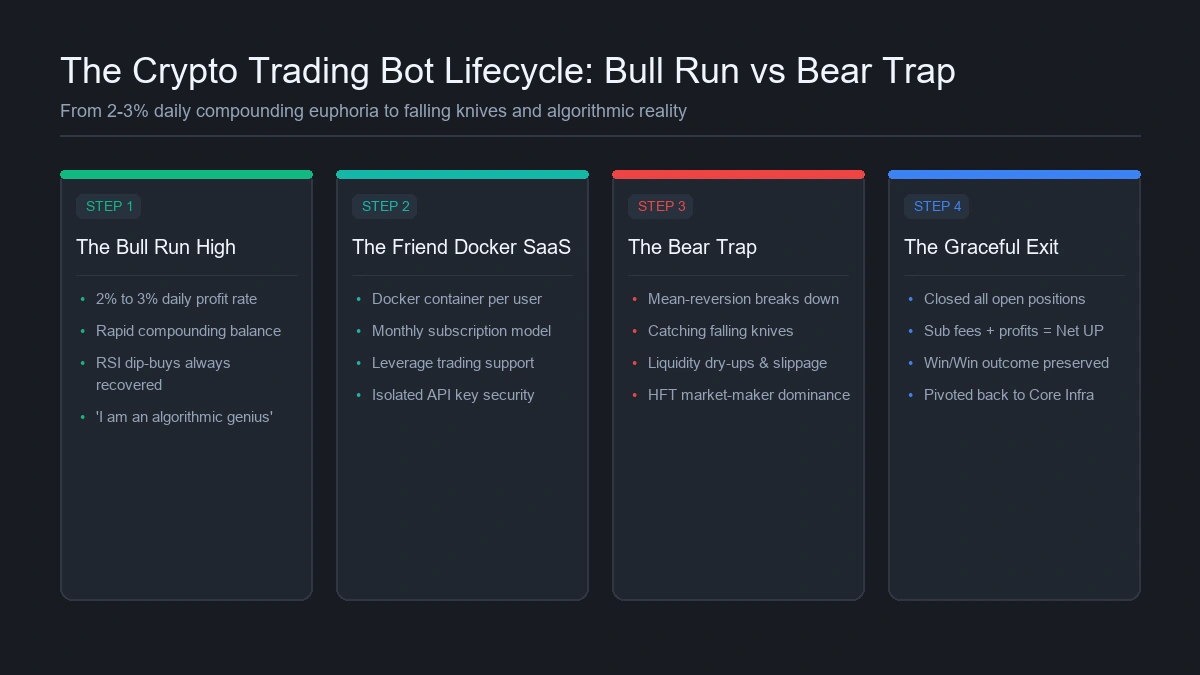 The algorithmic trading lifecycle: from early compounding euphoria to market reality and the graceful exit
The “I’m an Algorithmic Genius” Psychological Trap
When an algorithmic bot is printing money daily, your brain naturally falls into the classic trader’s fallacy: “I have cracked the market. I am a quantitative genius.”
In reality, a raging bull market is a massive rising tide that lifts all boats. When the underlying market trend is aggressively upward, virtually any dip-buying algorithm—no matter how simplistic—will look like a masterpiece:
┌─────────────────────────────────────────────────────────────────────────────────────────────┐
│                            The Bull Market Illusion vs Reality                              │
├─────────────────────────────────────────────────────────────┬───────────────────────────────┤
│ What You Think Is Happening                                 │ What Is Actually Happening    │
├─────────────────────────────────────────────────────────────┼───────────────────────────────┤
│ • My RSI threshold perfectly timed the reversal             │ • The macro trend is UP       │
│ • My mean-reversion formula outsmarted the exchange         │ • Buyers absorb every dip     │
│ • Compounding 2.5%/day will make me a billionaire in 2 years│ • High volatility masks risk  │
└─────────────────────────────────────────────────────────────┴───────────────────────────────┘
The algorithm was not outsmarting the market; the market momentum was simply forgiving every minor sub-optimal entry.
The Friend Docker Micro-SaaS
Naturally, word got out. A few close friends saw the bot’s daily performance logs and wanted in on the action.
Rather than sharing raw API keys or managing their funds directly, I spun up isolated Docker containers for each of them on my home server. Each container ran its own bot process connected to their personal exchange API keys, complete with configurable risk parameters and leverage trading support.
They paid a small monthly subscription fee to cover hosting and maintenance, and for months, everyone was riding high on the compounding returns.
+-------------------+      +-------------------------------------------+
| Exchange API Feed | ---> | Docker Instance 1 (Dan)                   | ---> Orders Executed
+-------------------+      +-------------------------------------------+
                           | Docker Instance 2 (Friend A - 3x Leverage)| ---> Orders Executed
                           +-------------------------------------------+
                           | Docker Instance 3 (Friend B - Spot Only)  | ---> Orders Executed
                           +-------------------------------------------+
[bot-instance-dan] 2023-02-14 09:15:00 [STRAT] BTC/USDT RSI(14)=27.4 (Oversold) -> Placing LIMIT BUY @ $21,840.00
[bot-instance-dan] 2023-02-14 09:15:02 [ORDER] Order #847291 FILLED (0.15 BTC)
[bot-instance-friend1] 2023-02-14 09:15:02 [STRAT] Mirror trigger -> 3x Leverage Long (0.45 BTC equivalent)
[bot-instance-dan] 2023-02-14 14:30:10 [TAKE_PROFIT] Target hit @ $22,450.00 -> Profit: +$91.50 (+2.79%)
[bot-instance-friend1] 2023-02-14 14:30:11 [TAKE_PROFIT] Target hit @ $22,450.00 -> Profit: +$274.50 (+8.37% with 3x lev)The Bear Market Reality Check
Then the market cycle turned.
When volatility flipped downward and the macro trend shifted from expansion to distribution, the flaws of simple retail indicator bots were brutally exposed:
- Catching Falling Knives: Mean-reversion algorithms assume price will oscillate back to a historical moving average. In a true bear dump, price doesn’t revert—it punches through support levels and keeps falling.
- Order Execution & Slippage: During sudden flash crashes, order book liquidity evaporated. Stop-losses triggered late, resulting in significant slippage against automated institutional market makers.
- The Retail Disadvantage: In the dog-eat-dog world of quantitative finance, retail traders running Python scripts over home broadband cannot compete with institutional high-frequency trading (HFT) firms operating with co-located exchange servers and microsecond execution speeds.
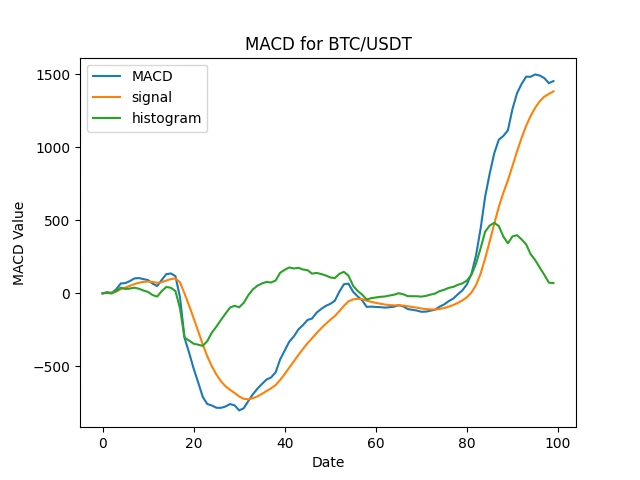 Backtesting indicator signals against historical candle volatility—visualizing where trend indicators lag during sharp market turns
The Graceful Exit: A Win/Win Finish
Recognizing that sustainable, all-weather quantitative trading requires advanced order-flow math and stochastic modeling far beyond basic RSI/MACD bots, I decided it was time to step away.
I systematically closed all open positions, shut down the Docker containers, and refunded any remaining subscription balances.
Because we took profits aggressively during the bull run and collected regular subscription revenue from the hosted instances, I was still solidly in profit overall. It was a genuine win/win outcome: great real-world experience, profitable trading during the run, and no catastrophic blown accounts.
I stepped away from crypto bot development to refocus my compute and energy on core systems, network automation, and infrastructure engineering—areas where deterministic, reliable code delivers value every single day without having to guess which way the market winds are blowing.
If you are curious about the technical architecture behind the bot, check out my build log on building an algorithmic crypto trading bot and backtester in Python, read about how my development workflows evolved in from ‘continue…’ to autonomous deployment, or explore my security postmortem on the Coldcard PRNG entropy vulnerability and hardware wallet verification.