For decades, plain text has been the gold standard for engineers who value data sovereignty, longevity, and control.
When you manage server fleets, write automation scripts, and build infrastructure, escaping proprietary database traps (like OneNote, Google Keep, or closed SaaS notes) is essential. Storing your working knowledge in a local directory of raw Markdown (.md) files versioned with Git guarantees that your notes will remain 100% readable on any operating system decades from now.
But while many of us adopted Markdown years ago through local-first tools like Obsidian, a much larger transformation has been quietly unfolding across software engineering:
Markdown has evolved from a simple human document format into the universal runtime protocol of the Agentic AI Era.
Because Large Language Models natively tokenize, generate, and reason through structured text with minimal token overhead, the entire AI industry has converged on .md files as the standard substrate for agent instructions, progressive tool capabilities, security guardrails, and persistent memory.
Here is a technical field guide to the emerging structured Markdown standards shaping modern autonomous AI workflows.
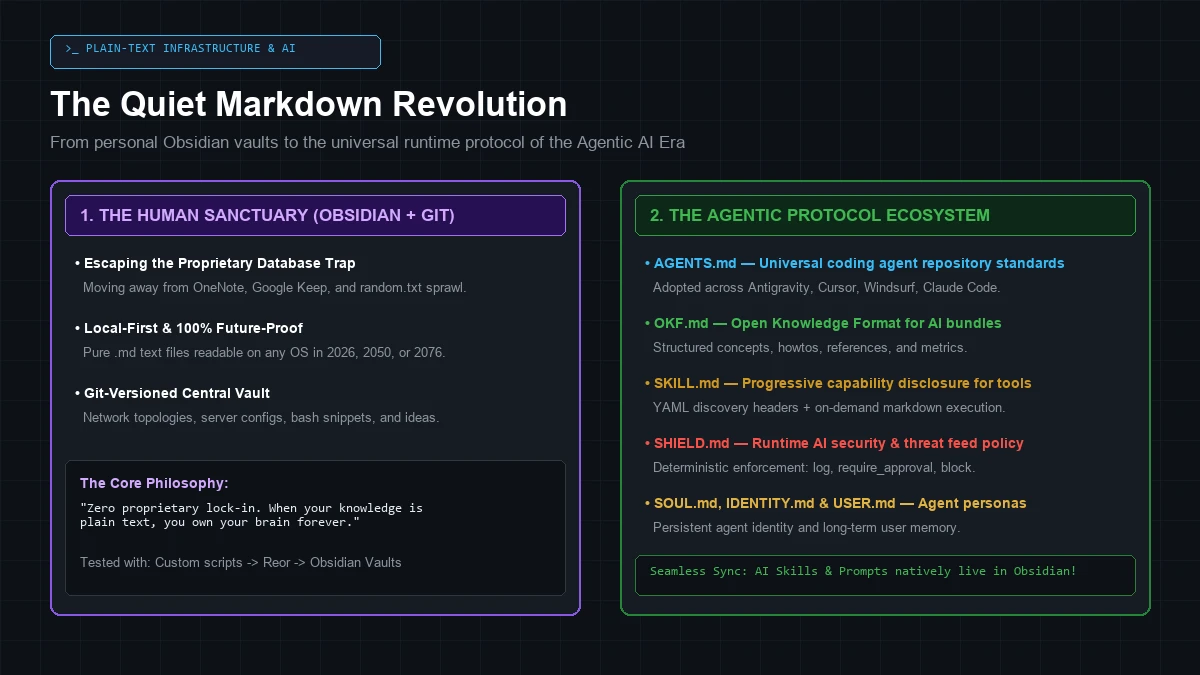 The modern plain-text landscape: how structured Markdown formats provide deterministic interfaces for autonomous AI coding agents and human operators alike.
Why Agentic AI Chose Markdown
When designing autonomous multi-agent coding pipelines, picking an interchange format is a fundamental architectural decision.
JSON and YAML are rigid; while excellent for raw data serialization, they consume excessive token overhead for complex natural-language instructions and lack intuitive readability during human Git pull-request reviews. Raw unstructured text, on the other hand, lacks deterministic syntactic boundaries.
Markdown struck the cryptographic sweet spot:
┌─────────────────────────────────────────────────────────────────────────────────────────────┐
│                             Why Markdown Powers Agentic AI                                  │
├───────────────────────────────┬───────────────────────────────┬─────────────────────────────┤
│ 1. Token Efficiency           │ 2. Dual-Readability           │ 3. Deterministic Parsing    │
│ • Minimal syntax overhead     │ • Effortless human review     │ • Natural LLM AST tokening  │
│ • Compact header & list tags  │ • Clean Git diff reviews      │ • Standardized frontmatter  │
└───────────────────────────────┴───────────────────────────────┴─────────────────────────────┘
By pairing YAML frontmatter (for machine-readable metadata discovery) with standard Markdown bodies (for procedural execution), engineers can construct composable, modular agent architectures with zero proprietary SDK lock-in.
The Structured .md Standards Ecosystem
Modern AI agent architectures divide responsibilities across specialized Markdown files. Rather than dumping tens of thousands of tokens into a single monolithic prompt, systems rely on discrete, purpose-built specifications.
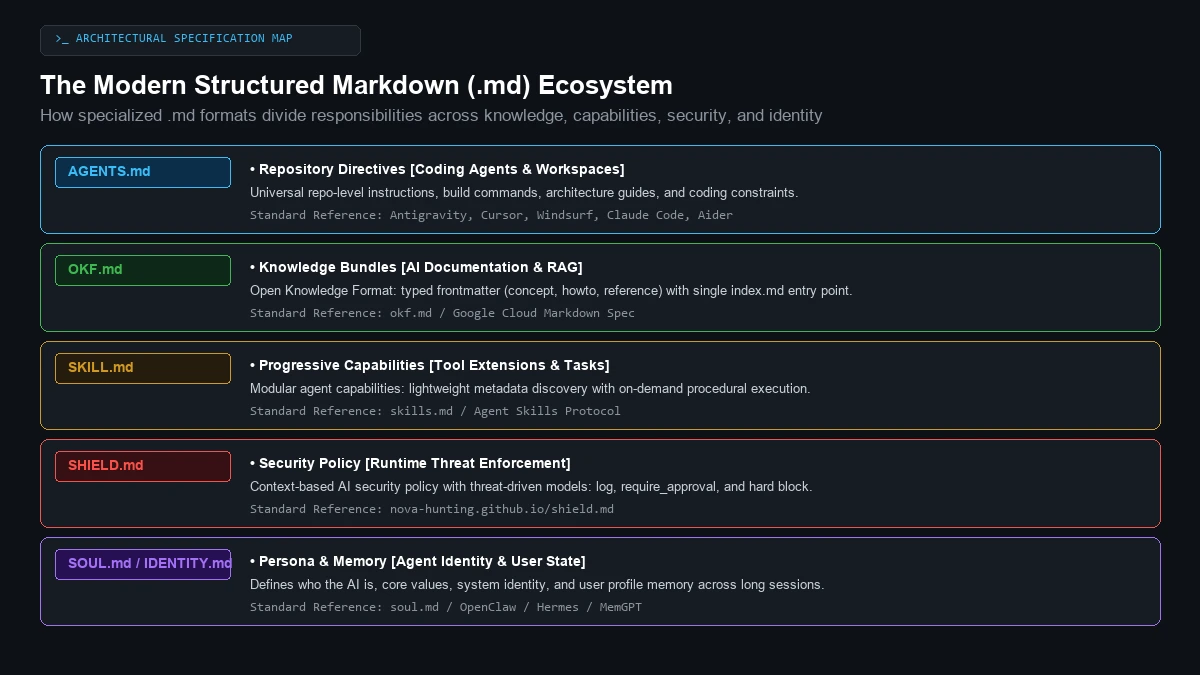 The modern structured Markdown landscape: dividing responsibilities across directives, knowledge bundles, capabilities, security policies, and agent identities.
1. AGENTS.md — Universal Repository Directives
If you work with modern AI coding environments like Antigravity, Cursor, Windsurf, Claude Code, or Aider, AGENTS.md has become the de facto industry standard for repository-level agent governance.
Placed in the root directory of a project, this file acts as the single source of truth for any AI agent interacting with the codebase:
# AGENTS.md — Master Project Directives

## Build & Test Commands
- Development server: `npm run dev`
- Production build: `npm run build`
- Test suite: `pytest tests/ -v`

## Architectural Guidelines
- Zero framework runtime dependencies on client bundle.
- All server scripts must use UK English spelling and strict error handling.
- Preserve existing comments and docstrings during refactoring.
Why it matters: It eliminates repetitive prompting. When an agent opens a repository, it immediately ingests AGENTS.md to learn the build pipeline, linting constraints, and operational boundaries before writing a single line of code.
2. OKF.md (Open Knowledge Format)
The Open Knowledge Format (OKF) is an open, Git-native specification for packaging technical knowledge so that AI agents can consume it without relying on proprietary vector databases or specialized SDKs.
Based on the Google Cloud Markdown specification, OKF is built on three foundational rules:
- One Index, One Truth: Every knowledge bundle contains an
index.mdentry point that explicitly maps the bundle’s contents. - Typed Frontmatter: Every document declares a strict
typein its YAML frontmatter (concept,howto,reference,decision,metric). Agents route queries to the appropriate handler without fuzzy heuristics. - Git-Native Versioning: Knowledge bundles can be versioned, branched, and reviewed with standard Git workflows.
---
title: "Hardening Postfix Mail Transfer Agents"
type: howto
version: 1.0.0
tags: [security, mail, postfix]
---

# Hardening Postfix Mail Transfer Agents
Step-by-step procedural instructions for configuring SPF, DKIM, and DMARC...
3. skills.md / SKILL.md
As AI agents take on more specialized roles, stuffing every tool manual into the agent’s initial system prompt quickly causes context window bloat and increases hallucination rates.
The Agent Skills specification solves this through progressive disclosure:
┌─────────────────────────┐      ┌─────────────────────────┐      ┌─────────────────────────┐
│ Discovery Phase (Boot)  │ ---> │ Task Matching           │ ---> │ Runtime Execution       │
│ Reads YAML Frontmatter  │      │ Agent selects relevant  │      │ Loads full Markdown     │
│ (Minimal Token Usage)   │      │ skill for current task  │      │ instructions & scripts  │
└─────────────────────────┘ └─────────────────────────┘ └─────────────────────────┘- Discovery Phase: At startup, the agent only reads the lightweight YAML frontmatter (
nameanddescription) of available skills. - On-Demand Activation: When a user request matches the skill’s description, the agent dynamically pulls the full procedural Markdown instructions and bundled executable helper scripts (
scripts/) into active context.
---
name: debian-system-hardening
description: Practical 10-step checklist for auditing and securing Debian 12 servers.
allowed-tools: [run_command, view_file]
---

# Debian System Hardening Procedure
Execute the following verification commands to inspect SSH configurations...
4. SHIELD.md
When AI agents are equipped with shell access, MCP tools, and file modification capabilities, security policies must be deterministic rather than probabilistic.
SHIELD.md is an open, context-based runtime security policy standard for AI agents:
- Threat-Driven Model: Evaluates runtime events (tool calls, MCP connections, network sockets, secret reads) against structured threat feeds.
- Deterministic Action States: Matches trigger explicit enforcement levels:
log,require_approval, orblock. - Bounded Context: Maintains strict token limits, ensuring security policies cannot be bypassed through prompt injection or context overflow attacks.
---
shield_version: "0.1.0"
policy_id: "sec-ops-enforcement"
threats:
  - id: "threat-raw-privkey-read"
    category: "secret_read"
    action: "block"
    condition: "target_path =~ /\.(ssh|gnupg|env)/"
---
5. SOUL.md, IDENTITY.md & USER.md
In multi-agent and autonomous assistant architectures (such as OpenClaw, Hermes, and MemGPT), long-term operational memory is split across dedicated Markdown files:
- SOUL.md &
IDENTITY.md: Define the AI agent’s core persona, philosophical baseline, communication style, and ethical boundaries. It establishes who the agent is, rather than just what tools it can call. USER.md: Serves as the agent’s persistent memory of the human operator — technical preferences, active projects, infrastructure details, and operational history across sessions.
The Convergence: Plain Text as the Universal Substrate
The ultimate benefit of this emerging ecosystem is composability.
Because your personal engineering notes in Obsidian, your project repository guidelines in AGENTS.md, and your agent capabilities in SKILL.md are all plain Markdown:
- Zero Translation Layers: AI agents can read your documentation, generate structured knowledge bundles, and refactor code using the exact same format.
- Native Tooling Integration: You can search, diff, symlink, and version-control your entire operational stack with standard Unix tools (
grep,find,git). - No Vendor Lock-In: You remain in complete control of your knowledge, your prompts, and your agent workflows.
As we move deeper into autonomous multi-agent engineering workflows, the tools we use to build software will continue to evolve. But the foundational layer bridging human intelligence and machine execution remains pure, timeless plain text.