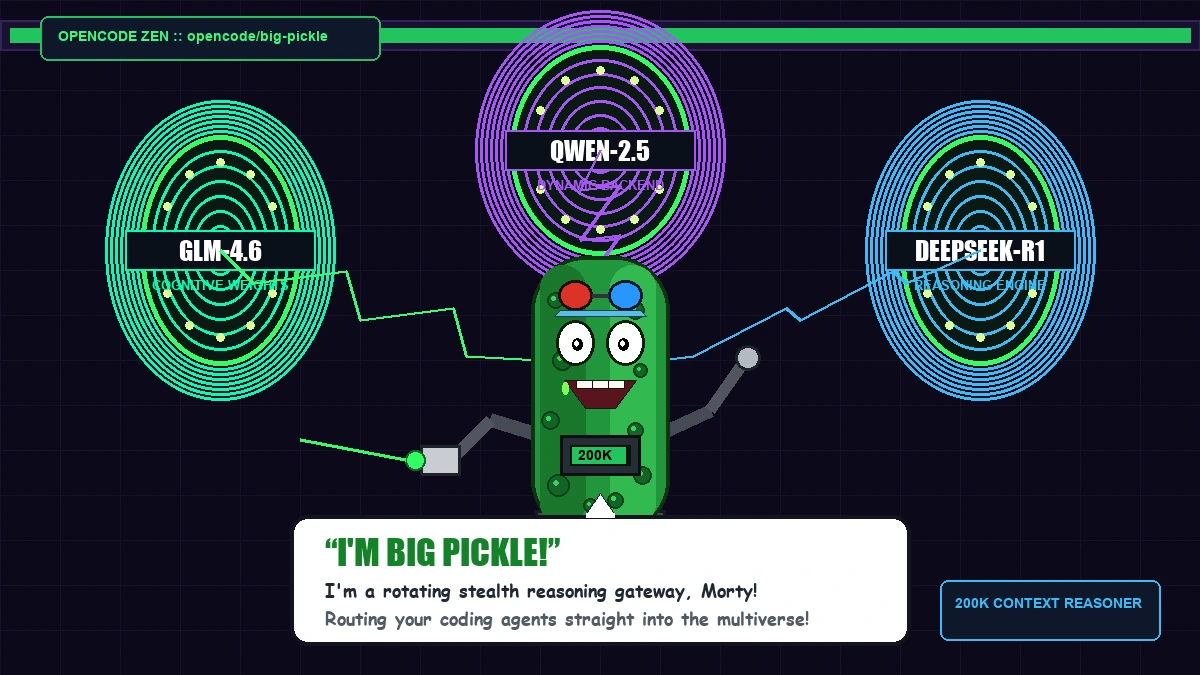
If you have been using coding agent platforms, terminal TUIs, or API gateways like OpenCode Zen, Mastra, or TypingMind recently, you have probably spotted an odd entry in the model picker: opencode/big-pickle (or simply “Big Pickle”).
With no flashy landing page or major lab press release attached to it, many developers assume it is an unannounced frontier model from a stealth startup.
The short answer? It isn’t a new standalone foundation model. Here is what “Big Pickle” actually is.
The Short Answer: OpenCode Zen’s Stealth Gateway
Big Pickle is an experimental, stealth reasoning tier hosted directly by the OpenCode Zen gateway.
In AI terminology, a “stealth” model is an evaluation endpoint where a provider serves pre-release, fine-tuned, or heavily benchmarked weights under an alias. This allows them to stress-test real-world developer workloads—like complex refactoring, multi-file code generation, and terminal tool calling—without prematurely locking in a formal public brand name.
Crucially, Big Pickle is dynamic. Rather than pointing to a static, unchanging checkpoint, OpenCode periodically rotates the underlying architecture behind the endpoint to benchmark and compare cutting-edge open and commercial reasoning weights (frequently drawing from high-end variants like GLM-4.6, DeepSeek, and Qwen).
Key Specs & Capabilities at a Glance
For developers wondering whether to route their coding agents through it, here is how the tier currently specs out:
| Specification | Current Endpoint Parameter |
|---|---|
| Model Identifier | opencode/big-pickle |
| Context Window | 200,000 tokens (200k) |
| Primary Strength | Deliberate multi-step code reasoning & debugging |
| Agent Capabilities | Native structured JSON outputs & agentic tool calling |
| Architecture Type | Rotating stealth backend (pre-release & staging weights) |
| Pricing / Access | Free promotional tier on OpenCode Zen (limited time) |
Why Use It?
Because Big Pickle is tuned specifically for coding agents within the OpenCode ecosystem, it focuses heavily on chain-of-thought analysis and agentic tool execution. It behaves much more like a dedicated reasoning engine (similar to o1/o3-mini or DeepSeek R1) than a casual conversational chatbot.
If you see opencode/big-pickle listed in your development environment, you are looking at an aggressive, free-tier reasoning proxy. It gives developers high-context, tool-capable reasoning power without burning through API credits—while giving the platform valuable telemetry on how modern code models handle production repositories.