Back in the mid-2000s, long before managed cloud firewalls and automated edge scrubbing existed, running and securing IRC networks was a constant, high-stakes defensive battle. Between running my own IRC network and helping out as a Technical Admin on several peer communities (including Your-IRC, DarkChat, and TalkCrap), keeping servers online meant dealing with an endless onslaught of connection storms, open proxy swarms, and malware-driven drone botnets.
When hundreds or thousands of compromised machines were commanded by a remote attacker to storm an IRC daemon on port 6667 simultaneously, human network operators (IRCops) typing manual /kill and /gline commands simply could not keep up.
To keep the server daemons alive and protect channels across the networks from being flooded off, I decided to automate the entire detection and mitigation pipeline. That system was SecureServ — a multi-network security bot I wrote to intercept, analyze, and neutralize incoming threats in fractions of a second.
The Mid-2000s Threat Landscape: SDBot, Fyle, and Open Proxies
Securing an IRC daemon in the 2000s meant understanding the specific malware strains and exploit vectors of the era:
1. SDBot & Gaobot Backdoor Botnets
SDBot (and its variants like Spybot and Gaobot) was one of the most prolific IRC-controlled backdoor families of the decade. It infected unpatched Windows XP and 2000 machines by scanning the internet for vulnerable RPC-DCOM (MS03-026) and LSASS (MS04-011) services on ports 135, 139, and 445.
Once a machine was rooted, the malware installed itself as a hidden background process, silently connected to a hardcoded IRC server, and sat in an encrypted C2 channel waiting for commands (like launching raw TCP SYN floods, executing .download URLs, or scanning adjacent subnets). When attackers turned their bots toward legitimate chat networks, hundreds of infected machines would join simultaneously to disrupt servers and spread download droppers.
2. The Fyle Trojan & mIRC Script Hijackers
Unlike standalone binary backdoors, the Fyle trojan specifically targeted the IRC ecosystem itself. It spread by exploiting mIRC client vulnerabilities and social engineering, silently overwriting local script.ini, mirc.ini, and remote.ini files.
Once hijacked, the user’s mIRC client would execute hidden background routines: opening unauthorized DCC SEND file transfers to everyone in a channel, spamming disguised download links ("Come watch me on my webcam..."), and launching synchronized message floods.
3. WinGate & SOCKS Open Proxy Swarms
During the transition from dial-up to early broadband (ADSL and cable), many home users unwittingly ran open proxy services (like misconfigured WinGate software or unprotected SOCKS4/5 and HTTP proxies). Attackers scanned residential IP ranges to build massive proxy lists, routing their flooding bots through hundreds of distinct residential IPs to bypass standard hostmask bans.
4. Nick Flooding & Topology Desynchronization
IRC networks operated on a hub-and-leaf server topology linked by server-to-server TCP connections. Attackers wrote scripts to connect multiple clones and change nicknames four or five times a second. The resulting flurry of global broadcast traffic could overwhelm server message buffers, causing split-routing and dropping entire server leaves off the network (a “netsplit”).
The State of IRC Defence: Why Traditional Tools Left Networks Vulnerable
At the time, most IRC networks relied on one of three defensive mechanisms, all of which had significant operational limitations:
- Standard Services Packages (Anope, Epona, IRCServices): Focused strictly on authentication and registration (
NickServ,ChanServ,OperServ). They were completely passive —OperServrequired human operators to manually issue AKILLs, with no automated real-time DNSBL lookups or malware signature detection. - Eggdrop Bots with TCL Scripts (
sentinel.tcl,chanprotect.tcl): Excellent for localized channel ops (recovering ops after a takeover or kicking flooders), but they were channel-bound. They had no visibility into globalSNOTICEserver notices, could not drop network-wide G-Lines, and could not operate across multiple independent networks. - Dedicated Linux C Daemons (BOPM): The Blitzed Open Proxy Monitor was one of the few tools actively checking DNSBLs, but it required root access on Linux, complex compilation, and a direct IRCd oper block on the local host. This made it impossible to deploy across multiple third-party or peer networks where I only held Technical Admin or oper status.
On smaller and independent networks, services packages were often either completely absent or prone to severe netsplit lag during floods. When a 200-drone connection storm hit a fragile leaf server, the server links would split, leaving channels defenseless.
By combining real-time SNOTICE stream parsing, asynchronous DNSBL resolution, and cross-network background sockets into a privileged oper client, SecureServ provided a significantly stronger defensive posture across both my own network and the peer networks I assisted:
| Defence / Tooling Approach | Primary Role in the 2000s | SNOTICE Stream Parsing | Asynchronous DNSBL Lookups | Cross-Network Threat Feeds | Multi-Network Oper Mobility |
|---|---|---|---|---|---|
| Standard Core Services (Anope, Epona, IRCServices) | Passive user/channel auth (NickServ, ChanServ, manual OperServ) |
❌ No | ❌ No | ❌ No | ❌ Linked to single IRCd |
| Eggdrop Bots (TCL scripts) | Channel-level ops & takeover protection | ❌ No (Channel-bound) | ❌ No | ❌ No | ❌ Channel-bound |
| BOPM (Blitzed Open Proxy Monitor) | Dedicated Linux C daemon for DNSBL checking | ❌ Limited | ✔ Yes (opm.blitzed.org) |
❌ No | ❌ Single host only |
| SecureServ (Custom Automation Hub) | Proactive 4-tier detection, DNSBL, threat feeds, and auto-G-Lines | ✔ Yes (Real-time delta velocity) | ✔ Yes (Blitzed + Tor DNSBL) | ✔ Yes (UnderNet Fyle crawler) | ✔ Yes (Raw TCP oper sockets) |
1. Sniffing Real-Time Events with SNOTICE Streams
The core of my real-time defence engine was tapping directly into the IRC daemon’s raw server notice (SNOTICE) stream. By subscribing the bot to oper notices as they fired on the hub server, SecureServ could inspect incoming clients and measure connection velocity before the user could even join a channel:
; Measure connection intervals and detect connection hammering
on *:SNOTICE:*client connecting*: {
  set %con.reconnect $calc($ctime - %con.last-time)
  set %con.last-time $ctime
}

; Progressive sliding-window rate-limiting for nickname churn
on *:SNOTICE:*changed his/her nickname*: {
  inc %secure. [ $+ [ $5 ] ] 1
  if (%secure. [ $+ [ $5 ] ] == 4) {
    msg $11 Stop changing nicknames for 5 minutes or you will be banned.
  }
  if (%secure. [ $+ [ $5 ] ] == 5) {
    gline $11 600 :Nickname Flooding - Temporary 10-Minute Ban
  }
  if (%secure. [ $+ [ $5 ] ] == 6) {
    gline $11 :Nickname Flooding - Permanent Network Ban
  }
  ; Reset counter after sliding window expiration
  timer $+ $5 1 300 unset %secure. [ $+ [ $5 ] ]
}
Instead of waiting for an operator to see the flood, the sliding-window timer caught rapid nick-changers on their fourth attempt, issued a temporary 10-minute network G-Line on the fifth, and dropped a permanent network ban on the sixth.
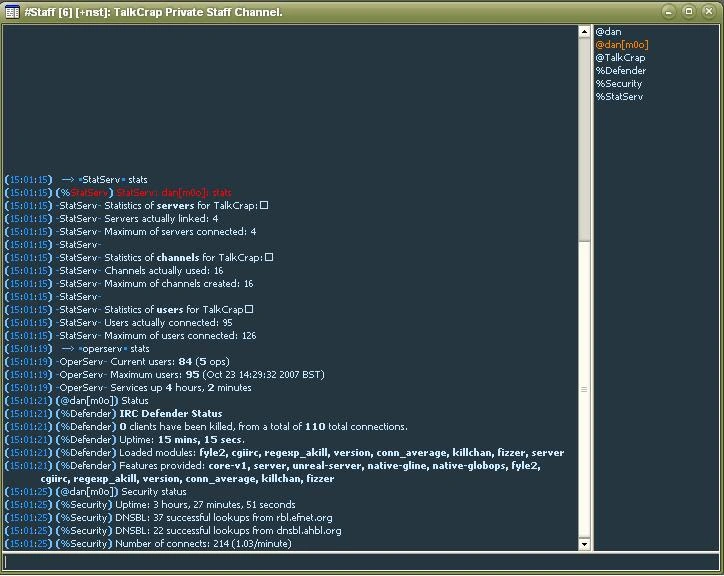
Authentic mIRC view of the #SecureServ control room monitoring real-time SNOTICE streams, drone scans, and global oper notifications
2. Asynchronous DNSBL & Open Proxy Lookups
To defeat proxy swarms, every newly connecting IP address was parsed into reverse octets and checked against real-time DNS Blackhole Lists (DNSBL) over asynchronous DNS sockets:
alias IPCheck {
  set %ip.1 $gettok($1,1,46)
  set %ip.2 $gettok($1,2,46)
  set %ip.3 $gettok($1,3,46)
  set %ip.4 $gettok($1,4,46)

  ; Query Blitzed Open Proxy Monitor (OPM)
  .timer 1 $r(1,3) /dns %ip.4. $+ %ip.3. $+ %ip.2. $+ %ip.1.opm.blitzed.org

  ; Query early Tor exit node blacklist
  .timer 1 $r(1,3) /dns %ip.4. $+ %ip.3. $+ %ip.2. $+ %ip.1.tor.dnsbl.sectoor.de
}- Blitzed OPM (
opm.blitzed.org): A legendary open-proxy monitor that actively tested connecting hosts for open HTTP, SOCKS4, SOCKS5, and WinGate proxies. - Sectoor Tor DNSBL (
tor.dnsbl.sectoor.de): An early DNSBL tracking active Tor exit nodes being leveraged for ban evasion and automated abuse.
If a positive record returned, SecureServ immediately issued an automated network-wide G-Line and logged the incident into Loggedkills.txt with a unique incident ID.
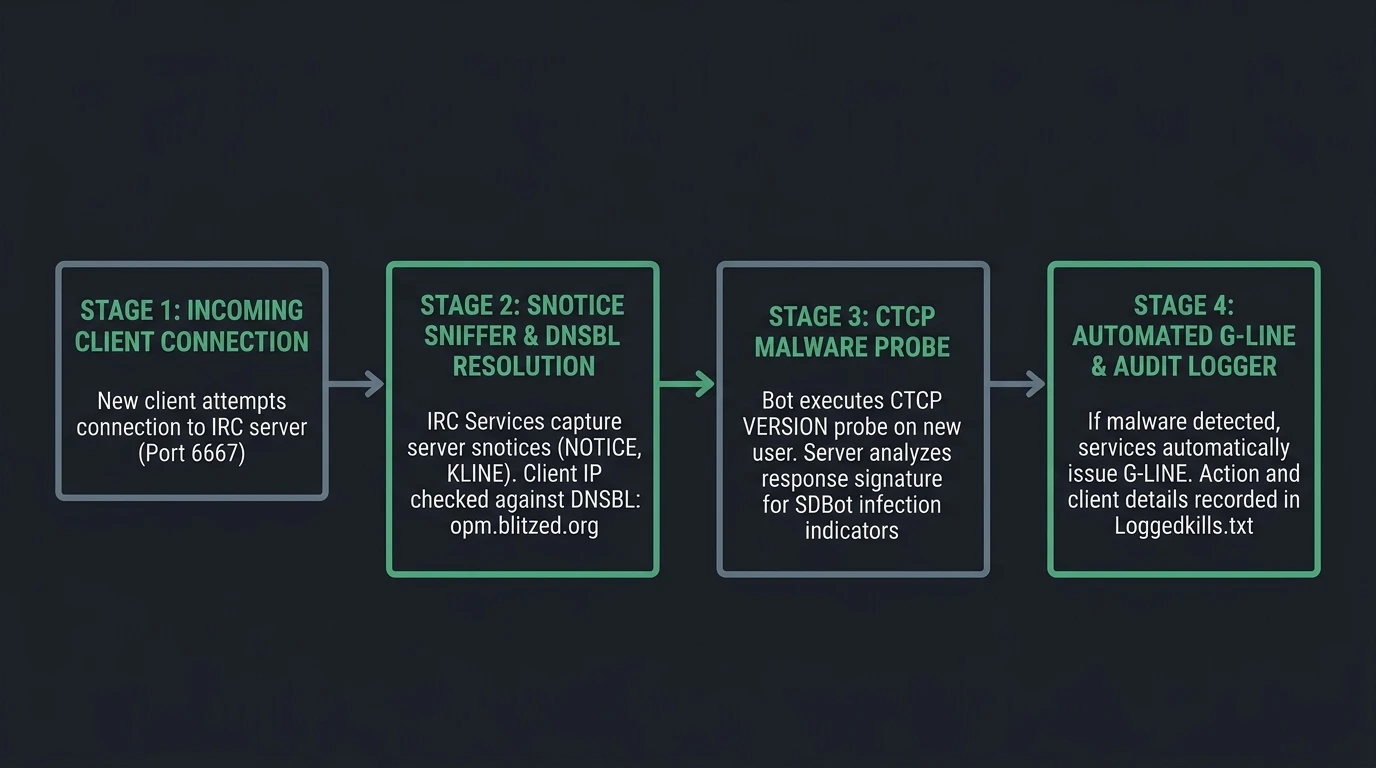
The 4-stage SecureServ detection pipeline: SNOTICE connection capture -> asynchronous DNSBL resolution -> CTCP malware probe -> automated G-Line and audit logging
3. Non-Blocking Hash-Table DNS Queues
Because mIRC was fundamentally single-threaded, running dozens of synchronous DNS lookups during a connection spike would freeze the client interface. To prevent UI lockups, SecureServ used dynamic hash tables ($+(dnsexec.,$cid)) to queue, track, and process concurrent DNS resolutions asynchronously:
; Asynchronous DNS execution callback using memory hash tables
alias dnsexec {
  var %table = $+(dnsexec.,$cid)
  if (!$hget(%table)) { hmake %table 100 }
  hadd -m %table $1 $2-
  .dns $1
}

on *:DNS: {
  var %table = $+(dnsexec.,$cid)
  if ($hget(%table,$dns(0).nick)) {
    var %callback = $hget(%table,$dns(0).nick)
    hdel %table $dns(0).nick
    ; Execute designated security callback with resolved IP
    %callback $dns(1).ip
  }
}
This ensured that lookups for large connection bursts completed smoothly in the background without dropping oper sessions.
4. Malware Fingerprinting & SDBot Neutralization
Many botnet strains had distinctive signatures in their CTCP version responses or protocol handshakes. By sending an automatic CTCP VERSION probe upon connection, SecureServ could identify backdoors instantly:
on *:ctcpreply:version*: {
  if (sdbot isin $1-) {
    kill $nick SDBot Malware Detected - Scan your PC for infections.
  }
  if (mIRC v6.01 isin $1-) || (mIRC v6.02 isin $1-) {
    notice $nick Your mIRC version has known critical buffer overflow vulnerabilities. Please upgrade.
  }
}
If an infected client answered with an SDBot signature, it was killed on the spot before it could receive attack commands. At the same time, the bot warned legitimate users running unpatched mIRC 6.01/6.02 clients that were vulnerable to remote arbitrary code execution exploits.
5. Cross-Network Threat Feeds & UnderNet Sync
Because I held technical and operator permissions across multiple distinct IRC networks, maintaining isolated defensive rules on each network was redundant. Using raw TCP sockets, SecureServ maintained persistent background socket connections to peer IRC daemons (like UnderNet and DarkChat):
alias other-conn {
  sockclose other-serv*
  sockopen other-serv irc.darkchat.co.uk 7000
  set %s.nick Secure $+ $r(1,999999)
  msg #SecureServ (DC) Connecting to DarkChat Security Hub
}

on *:sockopen:other-serv: {
  if ($sockerr > 0) { msg #SecureServ (DC) Socket Error | return }
  sockwrite -n $sockname nick %s.nick $crlf user secure sec sec sec :Security Oper Relay
}
This socket architecture enabled SecureServ to run an automated threat intelligence crawler on UnderNet (Amsterdam.NL.Eu.UnderNet.org), extract active Fyle trojan drone signatures and IP ranges from global channels into today-list.txt, and automatically import those IP bans into the local network databases (UN-ban.ini) before the attack wave ever hit the servers.
6. Channel Honeytraps & Join-Cycling Defence
For high-traffic public channels that were frequently targeted by spambots, I built two active channel protection layers into the bot:
- The Fast-Spam Honeytrap: Automated spambots would blast their payload the millisecond they received the
JOINevent. SecureServ enforced a strict 5-second silence window (set -u3 %check. $+ $address($nick,3)) on new joins. Any client messaging before the timer elapsed was immediately banned (/kline $nick :Spambot Detection - Banned). - Join / Part Cycling: The bot tracked user join/part velocity per hostmask, dropping temporary bans on drones attempting to flood channel logs by rapidly cycling in and out.
7. Pushing Live Metrics over Raw HTTP Sockets
Years before webhooks and RESTful bot APIs became standard, I programmed SecureServ to keep the community website updated by opening raw HTTP sockets directly to the web server on port 80:
; Push live channel metrics and uptime to website dashboard
alias update-stats {
  set %users.datoware $nick(#datoware,0)
  sockopen webstats r110.easily.co.uk 80
}

on *:sockopen:webstats: {
  sockwrite -n webstats GET /home/stats-update.php?users= $+ %users.datoware $+ &last= $+ %last.nick $+ &uptime= $+ $uptime HTTP/1.0
  sockwrite -n webstats Host: r110.easily.co.uk
  sockwrite -n webstats $crlf
}
This simple HTTP socket script pushed active user counts and recent network joins to a remote PHP dashboard, giving visitors a live view of network health.
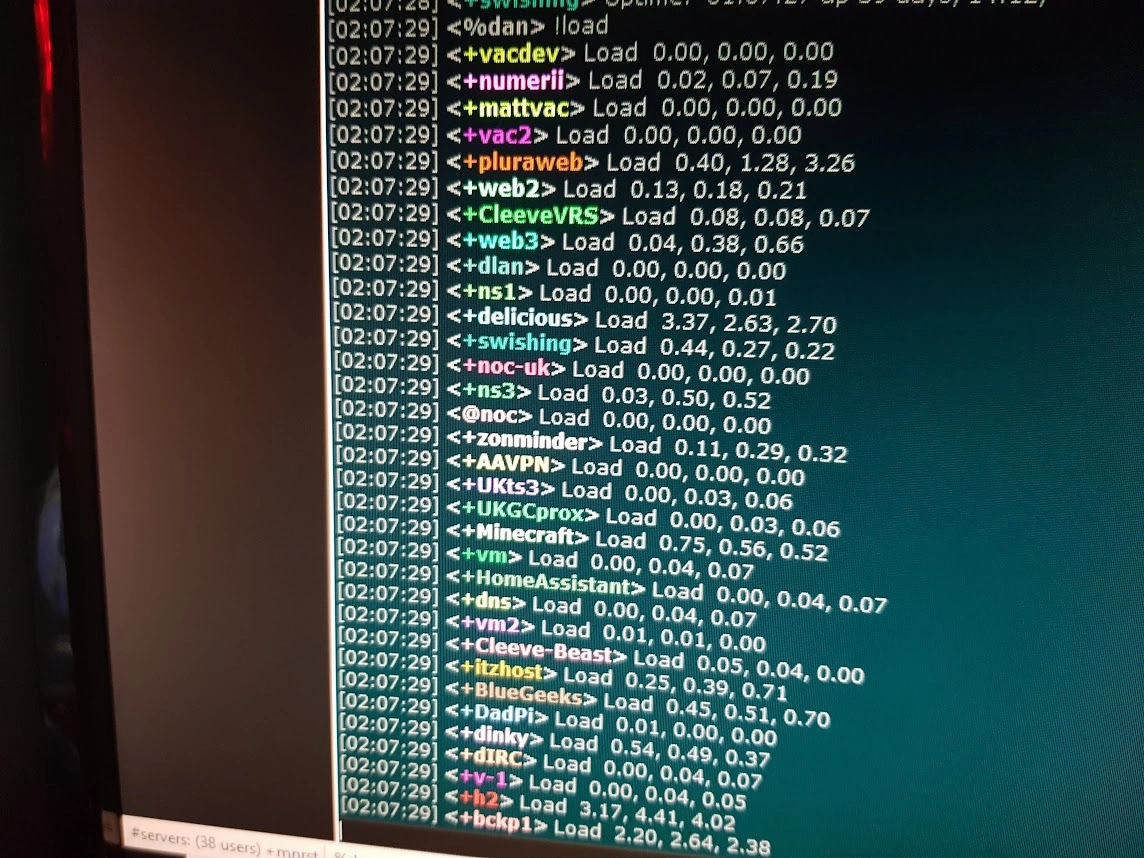
Monitoring remote Linux server loads, disk health, and network uptime directly from mIRC status windows
8. The MSN Messenger GUI Bridge
Managing technical operations across multiple chat networks meant having too many desktop applications open at once. To streamline things for myself and the other network staff who used the bot, I built a full graphical MSN Messenger bridge into SecureServ using mdx.dll (for Windows toolbars and icons) and msn.dll:
alias sbot.msn { dialog -m sbot.msn sbot.msn }
alias mdx { return system/dlls/mdx.dll }
alias msn { return system/dlls/msn.dll }

; Direct MSN contact management and file transfers from inside mIRC
on *:dialog:aruser:*:*: {
  if ($did == 6) { $dll($msn,AddContact,$did(aruser,5)) }
  if ($did == 8) { $dll($msn,Remove,$did(aruser,5)) }
}
Operators could sign in to their MSN accounts, add/remove contacts, view profiles, and send files without having to launch the separate Windows Live Messenger desktop client.
9. A Touch of Community Fun: The Christmas Counter
Even in the middle of mitigating floods, I kept lighthearted community features running. SecureServ hosted an automated holiday countdown module in channels like #ChristmasCounter and #TalkCrap, accompanied by a favorite oper running joke among the network staff:
“Hopefully the Christmas will come when the Bots stop trying to kill our fun.”
How 2000s IRC Defence Shaped Modern Server Security
Looking back at these mid-2000s systems, the direct lineage between early IRC network automation and modern enterprise security is striking:
- Event-Driven Log Parsing: Reading raw
SNOTICEstreams to drop G-Lines directly mirrors how tools like Fail2ban parse SSH auth logs to update iptables/nftables. - Asynchronous Reputation Lists: Early Blitzed OPM and Tor DNSBL checks paved the way for modern IP reputation feeds, ASN-based firewall filtering, and cloud threat intelligence.
- Audit Logs & Incident Verification: Maintaining persistent incident logs (
Loggedkills.txt,Connects.txt) directly reflects modern SIEM logging and automated security auditing tools.
Securing chat networks was an intense, 24/7 technical challenge, but building real-time defensive tools provided the foundational hands-on training that directly translated into my career — from managing network switching and firewalls across central London data centres to designing automated intrusion mitigation for hosting clusters and mission-critical infrastructure.
If you enjoy practical server security guides, check out my 10-step security audit checklist for Debian and Ubuntu or my walkthrough on Linux authentication with PAM Panic.